AminoChain and ImYoo Are Building a Biobank the Future of Medicine Needs

Caspar Barnes
Biobanks sit at the heart of modern drug discovery. The samples and data they store have the potential to unlock treatments for thousands of complex diseases that continue to have gaps in our biological understanding.
The UK biobank for example, which contains over 500,000 participant samples and datasets, has alone led to over 18,000 scientific papers and over 2.5 million citations (UK Biobank, 2026).
While the promise is enormous, the true potential of biobanking is limited by a major flaw: broken and misaligned patient engagement. Biomedical consent today is typically a one-time extractive process where researchers aim to get as much permission from patients as possible, to use their samples and data as many times as possible. This dysfunction has real consequences; consent rates at some major institutions have dropped lower than 20% (Hathcock et al, 2020), a direct symptom of a system that offers patients nothing in return for one of the most intimate contributions they can make.
Beyond the low participation and consent rates, losing connection to the bio-sample donor prevents researchers from both gathering any real world data on patients, and from returning any research insights back to them. Poor patient engagement therefore limits research by severing the links between wet lab data and a patient's lived experience, and by limiting the translational effect of research and clinical care. Biobanks themselves recognize these failures, but they are structurally trapped; they assume serious governance responsibilities while operating in under-resourced and complex environments, and are therefore unable to return value, results, or transparency to the very donors who made their work possible.
A New Way Forward
A new biobanking model that meets patients where they are, and redistributes governance, incentives, and value across all research stakeholders, is the way forward. We call it “decentralized biobanking”; when patients are treated as true research stakeholders, kept informed, fairly incentivised and given a reason to stay engaged, they remain contactable and motivated to consistently contribute to research. Longitudinal data that would otherwise be impossible to collect becomes accessible, and distributive justice becomes not a brake on translational science but the engine that drives it. AminoChain and ImYoo are teaming up to demonstrate this new model for the future of biobanking.
AminoChain is the operating system.
Decentralized biobanking poses interesting challenges and demands creative solutions around patient identity, consent management, sample and data governance, and incentive-designs.
How can you prove that a donated sample or dataset pertains to a particular person, without knowing their actual identity? How do you keep patients engaged and reachable long after their initial donation? How do you maintain trust, security, and regulatory compliance across jurisdictions? AminoChain tackles all of these questions through advanced cryptography and blockchain-based sample and data tracking, which standardizes patient identity and consent, and automates compliance and reporting.
Until today, more than 25 leading domestic and international biobanks, with over 500,000 specimens from approximately 150,000 unique donors, have been listed onto AminoChain’s “Specimen Center” search engine. The Specimen Center is a platform where biobanks can list their existing (or retrospective) sample collections to be searched for by a network of researchers. ImYoo is the first of these 25 biobanks to administer a sample collection on the “AminoChain protocol”; which will allow patients to track how their samples are used, earn incentives, and stay re-contactable for future research.
ImYoo is the Lab and Data Layer.
ImYoo is enabling precision medicine from home. Their team has pioneered a method for reading out high-resolution (think cells, proteins, and RNA) signals on how the immune system functions from small capillary blood volumes, backed by IP from Caltech. What this means in practice is that patients can self-collect samples from home, at the exact moments that matter most clinically (during a flare, during remission, during a treatment transition), rather than whenever they happen to be scheduled for a clinic visit.
ImYoo's innovation is not only their technology, but also the operational methods that this unlocks. Anyone who has been exposed to the world of patient engagement and clinical research knows first hand how frustrating it is for patients to drive hours from hard to reach areas, partake in painful sample extractions, and leave again with little information or true compensation. ImYoo’s at-home collection capacity not only saves time and money, but it changes the game for patients because it meets them where they are. This dovetails nicely into ImYoo’s unique philosophy; ImYoo is the first capillary blood biobank to treat its sample donors as an integral, ongoing part of its inventory, rather than a one-time source to be tapped and forgotten. For ImYoo, patient engagement is a core KPI as the more engaged the donor network is, the richer and more longitudinally valuable the biobank becomes.
ImYoo calls this their Patient Scientist Network: a community of bio-sample contributors who are consistently called upon to enrich the biobank and data lake, and to whom fair value is consistently returned, in the form of scientific findings, commercial benefit, and potentially, down the line, genuine governance rights over the biobank itself. It is a fundamentally different relationship between a biobank and the people who make it possible, and it is the model that the rest of the field will eventually have to follow.
Why This Matters: The Study and the Science
Autoimmune conditions like IBD, Rheumatoid Arthritis, Lupus, and Psoriasis share a defining characteristic in that their biology is dynamic and episodic. The molecular signals and the immune cascades that drive a flare are transient and difficult to track, particularly as there are many undefined lifestyle and environmental factors that contribute to the disease phenotypes (Miller, 2025). These chronic conditions drastically affect patient wellbeing, and the science behind them is complex and poorly understood. That is exactly why AminoChain and ImYoo have chosen to initially focus on one devastating autoimmune disease: Myasthenia Gravis (MG).
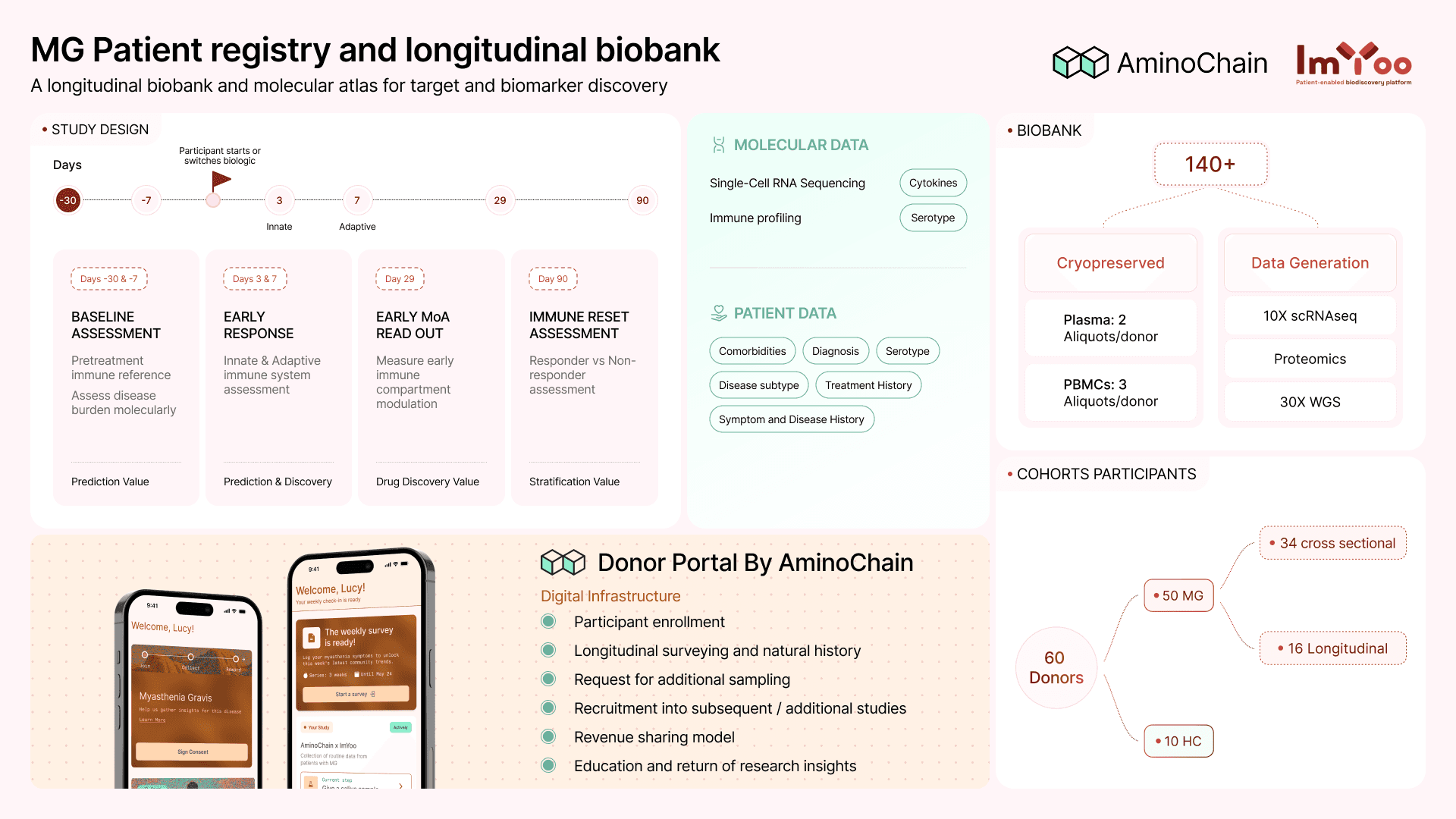
The two teams together conduct outreach, advocacy, and social media marketing to reach MG patients and advertise the study. MG Patients sign up, are invited to download the AminoChain patient portal, and schedule an ImYoo test kit collection. When patients receive the test kits, they collect capillary blood at home and send the kits back to ImYoo’s lab in Palo Alto. When ImYoo receives the kit, they store the blood samples and generate multi-omic data on the patients, and the patients receive a personalized analysis of their disease immunology. For each step in the process, the patient earns small incentives (up to $250 for a longitudinal collection), and they can opt out and withdraw consent through the donor portal at any time.
Testimony from the MG community
@myastheniagravis.supportgroup
This secure and compliant bi-directional connection, between the samples and data in ImYoo’s lab and the patients at-home using the AminoChain Donor Portal, is the foundation on which longitudinal engagement, consistent data collection, and meaningful scientific and commercial benefit sharing can begin. Ultimately this will lead to something that has never existed before: a living, longitudinal, deeply characterized dataset on immune-mediated diseases, built from the ground up with patients as active, ongoing stakeholders.
Together, ImYoo and AminoChain close a gap that has defined the field for decades.
ImYoo and AminoChain share a foundational conviction: that biomedical research cannot reach its full potential without returning agency, transparency, and benefit to the people who make it possible. That shared value is the connective tissue of our partnership: AminoChain provides the digital infrastructure, the network, and the governance layer, ImYoo provides the wet-lab capability, the physical operations, and the patient community, but together, we collapse an invisible divide that has always existed between patients, biobanks, and scientists.
Behind every sample in a biobank is a person living with a condition that medicine has not yet solved. This partnership is about building the infrastructure, the trust, and the shared ownership that translational science has always needed, and never had. What makes this model so powerful is that when you get patient centricity right, science does not slow down, it speeds up. Engaged patients mean more longitudinal data, more longitudinal data means richer science, richer science means better treatments, developed faster, for diseases that have waited long enough.
AminoChain is the world's first decentralized biospecimen discovery and management platform. Learn more at aminochain.io
ImYoo is a patient-enabled biodiscovery platform coupling at-home blood collection with single-cell RNA sequencing. Learn more at imyoo.health
References
Hathcock, M.A. et al. (2020) ‘Characteristics associated with recruitment and re-contact in Mayo Clinic biobank’, Frontiers in Public Health, 8. doi:10.3389/fpubh.2020.00009.
Miller FW. Environment, Lifestyles, and Climate Change: The Many Nongenetic Contributors to The Long and Winding Road to Autoimmune Diseases. Arthritis Care Res (Hoboken). 2025 Jan;77(1):3-11. doi: 10.1002/acr.25423. Epub 2024 Sep 27. PMID: 39228044; PMCID: PMC11684977.
UK Biobank (2026) https://www.ukbiobank.ac.uk/discoveries-and-impact/

AminoChain and ImYoo Are Building a Biobank the Future of Medicine Needs
Biobanks are the backbone of biomedical research and drug discovery, safeguarding millions of human biospecimens including blood, tissue, DNA, and other biological materials, collected from donors across a variety of healthcare, research, and clinical settings. These invaluable resources fuel breakthroughs in disease research, new treatments, and the advancement of personalized medicine.

Caspar Barnes
Biobanks sit at the heart of modern drug discovery. The samples and data they store have the potential to unlock treatments for thousands of complex diseases that continue to have gaps in our biological understanding.
Biobanks sit at the heart of modern drug discovery. The samples and data they store have the potential to unlock treatments for thousands of complex diseases that continue to have gaps in our biological understanding.
Our Motivation
The UK biobank for example, which contains over 500,000 participant samples and datasets, has alone led to over 18,000 scientific papers and over 2.5 million citations (UK Biobank, 2026).
While the promise is enormous, the true potential of biobanking is limited by a major flaw: broken and misaligned patient engagement. Biomedical consent today is typically a one-time extractive process where researchers aim to get as much permission from patients as possible, to use their samples and data as many times as possible. This dysfunction has real consequences; consent rates at some major institutions have dropped lower than 20% (Hathcock et al, 2020), a direct symptom of a system that offers patients nothing in return for one of the most intimate contributions they can make.
Beyond the low participation and consent rates, losing connection to the bio-sample donor prevents researchers from both gathering any real world data on patients, and from returning any research insights back to them. Poor patient engagement therefore limits research by severing the links between wet lab data and a patient's lived experience, and by limiting the translational effect of research and clinical care. Biobanks themselves recognize these failures, but they are structurally trapped; they assume serious governance responsibilities while operating in under-resourced and complex environments, and are therefore unable to return value, results, or transparency to the very donors who made their work possible.
A New Way Forward
A new biobanking model that meets patients where they are, and redistributes governance, incentives, and value across all research stakeholders, is the way forward. We call it “decentralized biobanking”; when patients are treated as true research stakeholders, kept informed, fairly incentivised and given a reason to stay engaged, they remain contactable and motivated to consistently contribute to research. Longitudinal data that would otherwise be impossible to collect becomes accessible, and distributive justice becomes not a brake on translational science but the engine that drives it. AminoChain and ImYoo are teaming up to demonstrate this new model for the future of biobanking.
AminoChain is the operating system.
Decentralized biobanking poses interesting challenges and demands creative solutions around patient identity, consent management, sample and data governance, and incentive-designs.
How can you prove that a donated sample or dataset pertains to a particular person, without knowing their actual identity? How do you keep patients engaged and reachable long after their initial donation? How do you maintain trust, security, and regulatory compliance across jurisdictions? AminoChain tackles all of these questions through advanced cryptography and blockchain-based sample and data tracking, which standardizes patient identity and consent, and automates compliance and reporting.
Until today, more than 25 leading domestic and international biobanks, with over 500,000 specimens from approximately 150,000 unique donors, have been listed onto AminoChain’s “Specimen Center” search engine. The Specimen Center is a platform where biobanks can list their existing (or retrospective) sample collections to be searched for by a network of researchers. ImYoo is the first of these 25 biobanks to administer a sample collection on the “AminoChain protocol”; which will allow patients to track how their samples are used, earn incentives, and stay re-contactable for future research.
ImYoo is the Lab and Data Layer.
ImYoo is enabling precision medicine from home. Their team has pioneered a method for reading out high-resolution (think cells, proteins, and RNA) signals on how the immune system functions from small capillary blood volumes, backed by IP from Caltech. What this means in practice is that patients can self-collect samples from home, at the exact moments that matter most clinically (during a flare, during remission, during a treatment transition), rather than whenever they happen to be scheduled for a clinic visit.
ImYoo's innovation is not only their technology, but also the operational methods that this unlocks. Anyone who has been exposed to the world of patient engagement and clinical research knows first hand how frustrating it is for patients to drive hours from hard to reach areas, partake in painful sample extractions, and leave again with little information or true compensation. ImYoo’s at-home collection capacity not only saves time and money, but it changes the game for patients because it meets them where they are. This dovetails nicely into ImYoo’s unique philosophy; ImYoo is the first capillary blood biobank to treat its sample donors as an integral, ongoing part of its inventory, rather than a one-time source to be tapped and forgotten. For ImYoo, patient engagement is a core KPI as the more engaged the donor network is, the richer and more longitudinally valuable the biobank becomes.
ImYoo calls this their Patient Scientist Network: a community of bio-sample contributors who are consistently called upon to enrich the biobank and data lake, and to whom fair value is consistently returned, in the form of scientific findings, commercial benefit, and potentially, down the line, genuine governance rights over the biobank itself. It is a fundamentally different relationship between a biobank and the people who make it possible, and it is the model that the rest of the field will eventually have to follow.
Why This Matters: The Study and the Science
Autoimmune conditions like IBD, Rheumatoid Arthritis, Lupus, and Psoriasis share a defining characteristic in that their biology is dynamic and episodic. The molecular signals and the immune cascades that drive a flare are transient and difficult to track, particularly as there are many undefined lifestyle and environmental factors that contribute to the disease phenotypes (Miller, 2025). These chronic conditions drastically affect patient wellbeing, and the science behind them is complex and poorly understood. That is exactly why AminoChain and ImYoo have chosen to initially focus on one devastating autoimmune disease: Myasthenia Gravis (MG).
The two teams together conduct outreach, advocacy, and social media marketing to reach MG patients and advertise the study. MG Patients sign up, are invited to download the AminoChain patient portal, and schedule an ImYoo test kit collection. When patients receive the test kits, they collect capillary blood at home and send the kits back to ImYoo’s lab in Palo Alto. When ImYoo receives the kit, they store the blood samples and generate multi-omic data on the patients, and the patients receive a personalized analysis of their disease immunology. For each step in the process, the patient earns small incentives (up to $250 for a longitudinal collection), and they can opt out and withdraw consent through the donor portal at any time.
Testimony from the MG community
@myastheniagravis.supportgroup
This secure and compliant bi-directional connection, between the samples and data in ImYoo’s lab and the patients at-home using the AminoChain Donor Portal, is the foundation on which longitudinal engagement, consistent data collection, and meaningful scientific and commercial benefit sharing can begin. Ultimately this will lead to something that has never existed before: a living, longitudinal, deeply characterized dataset on immune-mediated diseases, built from the ground up with patients as active, ongoing stakeholders.
Together, ImYoo and AminoChain close a gap that has defined the field for decades.
ImYoo and AminoChain share a foundational conviction: that biomedical research cannot reach its full potential without returning agency, transparency, and benefit to the people who make it possible. That shared value is the connective tissue of our partnership: AminoChain provides the digital infrastructure, the network, and the governance layer, ImYoo provides the wet-lab capability, the physical operations, and the patient community, but together, we collapse an invisible divide that has always existed between patients, biobanks, and scientists.
Behind every sample in a biobank is a person living with a condition that medicine has not yet solved. This partnership is about building the infrastructure, the trust, and the shared ownership that translational science has always needed, and never had. What makes this model so powerful is that when you get patient centricity right, science does not slow down, it speeds up. Engaged patients mean more longitudinal data, more longitudinal data means richer science, richer science means better treatments, developed faster, for diseases that have waited long enough.
AminoChain is the world's first decentralized biospecimen discovery and management platform. Learn more at aminochain.io
ImYoo is a patient-enabled biodiscovery platform coupling at-home blood collection with single-cell RNA sequencing. Learn more at imyoo.health
References
Hathcock, M.A. et al. (2020) ‘Characteristics associated with recruitment and re-contact in Mayo Clinic biobank’, Frontiers in Public Health, 8. doi:10.3389/fpubh.2020.00009.
Miller FW. Environment, Lifestyles, and Climate Change: The Many Nongenetic Contributors to The Long and Winding Road to Autoimmune Diseases. Arthritis Care Res (Hoboken). 2025 Jan;77(1):3-11. doi: 10.1002/acr.25423. Epub 2024 Sep 27. PMID: 39228044; PMCID: PMC11684977.
UK Biobank (2026) https://www.ukbiobank.ac.uk/discoveries-and-impact/

AminoChain is a technology that connects enterprise medical institutions, providing the basis for developers to build user-owned decentralized healthcare applications.
Medical institutions install a software package called the “Amino Node”, which integrates into the institution's endogenous tech stacks (e.g. their EMR’s, Inventory Management Softwares, Data Capture Softwares etc). While data stays self-custodial on the given institutions servers, the Node software harmonizes and standardizes the data into a common format, making it interoperable with a network of collaborators. The Node software thereby sources data from all providers and brings credible neutrality to the network; from this basis, developers can source data from a multitude of medical bodies and build any number of patient centric applications.
The first application built on AminoChain, is a peer to peer bio-sample marketplace called the “Specimen Center”. In the Specimen Center, biobank inventories and their associated data are harmonized into a common format, making research samples searchable and requestable across a network of providers.
As context, biobanks are storage facilities for human tissue used in scientific research or clinical applications. Biobanks are used by researchers who are looking to create cures for new and existing diseases, as well as studying a population’s health to help prevent future outbreaks of infectious disease.
However, biobanks suffer from a dire lack of interoperability; it takes an average of 8 weeks emailing back and forth before researchers find the samples they need, sign a licensing agreement, and a sample is shipped.
With Specimen Center biobanks can now give permission for researchers and collaborators to query their sample collections, and they can equally query for research assets available to them. Between institutions, users can streamline licensing agreements, track sample and data use, and maintain full provenance of biosamples across an interoperable network of biobanks.

The best part of all of this: any biobank can enable features that let their patients/ sample donors track where their samples go in the network, learn from the information generated on their samples, and earn money back whenever their samples are commercialized or sold. What separates the AminoChain Specimen Center from traditional biosample marketplaces is the ability to embed transparency and benefit-sharing with the very people that make the marketplace valuable: the patients. Our goal is to prove that you can create an incredibly successful business by placing bioethics at the heart of the business model; if you care for the patient experience first and foremost, then downstream, everyone in the industry will benefit.
Our Vision for the Future
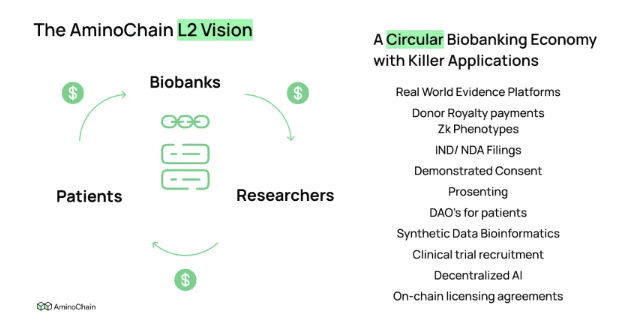
While the Specimen Center is the first application built on AminoChain, and biobanks are the first institutions being connected, these are just the first examples of what applications can be built and how big the network can be.
Medical bodies in the AminoChain network will be able to benefit from decentralized applications in clinical recruitment, clinical trial management, decentralized AI and federated learning, to name a few examples. In a world where science and healthcare applications are becoming increasingly user owned and self-custodial, AminoChain will be a key coordination layer to connect disparate data sources with bio-medical enterprises.
Our vision is to build the world's first HIPAA and GDPR compliant blockchain for the healthcare industry - a platform on which any company, network, non-profit, or lone scientist can source and build with compliant healthcare data. AminoChain is building more than a platform to improve bio-sample distribution; we’re building an entirely new bioeconomy. Within this new economy our mission is to streamline clinical R&D, improve academic-industry partnerships, and above all, to have patients be the very first to benefit from their participation in scientific research.
To help us achieve this vision we’re thrilled to bring on two investors with very different areas of expertise - a16z crypto and Cercano. This $5M seed round led by a16z crypto, brings our total funding to date to $7M.
Having worked closely with the a16z crypto team through the CSX London accelerator, we’ve been incredibly impressed with their deep technical and operating expertise, and we’re excited to welcome them aboard. We’re also very excited to welcome Cercano to the cap table. Having worked closely with the Cercano team over the last few months, we’ve been particularly impressed with their depth and breadth of knowledge across the Life Sciences, and we’re excited to work closely with their connected partners.
If you are a world class engineer or developer, a die-hard operator, or a true wordsmith and visionary, we would love to have you apply to join us. We are currently hiring across a number of founding roles and attached are our open positions and career’s page primer. We can’t wait to hear from you, and we’re excited to have you join our mission of bringing trust to science and healthcare.
There is nothing more personal than your body.
Every year thousands of people do an incredible service to humanity by providing the medical community with samples of their blood, saliva, and cancer tissue to help researchers develop new lifesaving medicines that benefit all of us.
Unfortunately, today, the data collected from these highly sensitive and personal samples and data, is a one way street.
Bio-sample donors are asked if their sample can be used for scientific research, they sign a consent document, the researcher takes the bio-sample, and the two part ways and never see each other again. The journey of donated samples is a black box for donors, and consent rates at major institutions are now as low as 25%.
While this data has immense potential to drive medical breakthroughs and improve patient care, its centralized storage and control (1) put a massive drag on scientific progress and the improvement of patient outcomes, and (2) prevent provenance and users’ consent management.
Limited Sample Visibility & Accessibility
Most biobanks operate in silos, with no centralized system for researchers to search, compare, or request samples across multiple repositories. This lack of visibility leads to duplicated collections, wasted resources, and underutilized specimens, slowing down critical research.
Cumbersome & Bureaucratic Procurement Processes
The process of acquiring biospecimens is manual, fragmented, and painfully slow. Researchers must contact multiple biobanks, negotiate Material Transfer Agreements (MTAs), verify ethical approvals, and coordinate logistics – a process that often takes 8+ weeks for a single transaction.
Lack of Transparency & Compliance Oversight
Once a sample is collected, it often disappears into a “black box”, with little traceability on its future use. Donors remain uninformed about how their contributions are used, while institutions struggle to enforce consent terms and regulatory compliance (e.g., GDPR, HIPAA, IRB approvals).